
Last Media Dollar “Live” is coming to NYC in 12 Days on February 25, 2026, at the Roxy Cinema in Tribeca. This is a live, on-stage decision-making experience where Chad Stoller (Global Head of Media, PMG), Stefanie Beach (CEO & Founder, The Marketeer Group), and Joe Zawadzki (General Partner at Aperiam Ventures) will think out loud and share how they navigate media channel trade-offs. The audience debate is intense and a lot of fun. Secure your ticket now to be in the room where the thinking happens.
Advertising Economic Forum Returns to New York City: March 18–19, 2026.
Day 1 at Horizon Media features eight AI founders pitching to our esteemed investor panel across agentic commerce, creative, and emerging agency models. Day 2 at The New York Times Center convenes 400 senior leaders for closed-door sessions examining market structure, incentives, and the economic forces reshaping advertising today. Early-bird registration is still open for 3 more days; space is limited.
Rebuilding the media value chain for an agentic AI world with Andrew Mole.
Quo Vadis had an insightful chat last week with Andrew Mole about how the media value chain is getting rebuilt for the agentic AI world. To set the scene, we began with a topic dominating the adtech/financial news cycle — Google’s giant AI capex bet.
Google told investors on its Q4/FY25 earnings call that it plans to invest $180 billion in capex (aka, operating fixed capital) over the near-term investment cycle. Brian Wieser from Madison & Wall covered this story last week (I recommend checking out his perspective).
Let’s put $180 billion of new investment in fixed assets into perspective. At the end of 2024, Google had $210 billion in total operating invested capital. $133 billion was fixed capital, and $77 billion was working capital.
With $180 billion in new investment, we interpret this to mean Google is aiming to replace its entire capital base (hardware, compute, etc.).
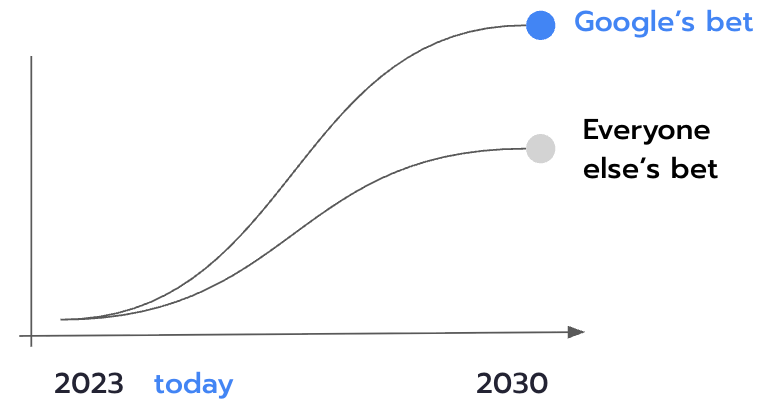
Case and Point: As far as we can, Google’s giant investment in new fixed capital is signaling a bet that AI tech and adoption are not only happening fast (obviously), but it’s going to happen even faster than the majority of the market thinks. In other words, it’s better to overinvest and be right than underinvest and be wrong.
4 Questions We Covered With Andrew
Check out the video recording to hear his answers and related commentary.
Q1 with Andrew: Why is AdCP (Predid Sales Agent) the most consequential shift across programmatic?
Q2 with Andrew: Prebid.org has taken over the code for the Ad Context Protocol (AdCP) to develop the Prebid Sales Agent, an open-source framework enabling publisher-side AI to autonomously manage, negotiate, and execute ad campaigns. This initiative aims to prevent vendor lock-in and standardize AI-driven advertising, providing an alternative to proprietary AI solutions while ensuring interoperability across the digital ecosystem. Good, Bad, or Indifferent?
Q3 with Andrew: Everyone is talking about “agentic AI,” but the industry is split on what actually changes: workflows, incentives, control points, and who captures value. What is structurally different in this cycle?
Q4 with Andrew: What does agentic unlock in today’s publisher stack to make curation scalable rather than manual and work in the publishers’ favor to avoid the sins of the programmatic era?
The Ideal State
We also covered the trampled topic of “transparency.” In adtech land, Quo Vadis treats the word “transparent” as synonymous with “trust.” Then we take it one step further and define trust as:
Confidence in a counterparty’s intentions.
This concept is important to prevent the agentic era from repeating the lemon-market mistakes of the RTB era. As our Quo Vadis community knows, the RTB era presented a classic “lemon market” asymmetry, where the sell-side had all the information about the quality of the impressions being offered. When marketing and procurement teams thought it was a good idea to allocate 20% or more to $1.00 “cheap reach” inventory, it incentivized the supply side to flood the market with subprime inventory. On the other side of the trade, buyers had difficulty distinguishing good from bad quality, so they priced programmatic inventory downward. As with all lemon markets, buyers eventually find equilibrium and exit the market altogether, a trend that became more noticeable in 2025 and continued into 2026.
Translation: The buy side of RTB had lost confidence in the seller’s intentions as the promise of programmatic failed to materialize (efficiency, transparency, quality, etc.).
The agentic world is a fresh start. Time will tell whether old habits and vested interests are hard to break or whether the tsunami of creative destruction ultimately delivers on the original promises. Quo Vadis is hopeful for the latter but paying attention to the former.
Disclaimer: This post, and any other post from Quo Vadis, should not be considered investment advice. This content is for informational purposes only. You should not construe this information, or any other material from Quo Vadis, as investment, financial, or any other form of advice.


