
Housekeeping
Last Media Dollar “Live” is coming to NYC: February 25, 2026. Following a wildly successful London debut, Last Media Dollar “Live” comes to New York City on February 25 at the Roxy Cinema in Tribeca. This is not a panel, it’s a live, on-stage decision-making experience where senior practitioners and the audience debate assumptions and reveal how media choices are actually made under real constraints, in real time. Seats are very limited and moving quickly. Secure your ticket now if you want to be in the room where the thinking happens.
Advertising Economic Forum Returns to New York City: March 18–19, 2026.
This year features an expanded two-day format focused on where media capital, ad innovation, and financial strategy are heading. Day 1 at Horizon Media features eight AI founder pitches to our investor panel with live debate across agentic commerce, creative, and emerging agency models. Day 2 at The New York Times Center convenes 400 senior leaders for closed-door sessions examining market structure, incentives, and the economic forces reshaping advertising. Early bird registration is still open for now; space is limited.
WEBINAR RECORDING: Inside C Wire’s AI Stack, How In-House Tools Are Creating Superhuman Productivity
On one hand, adtech companies can layer AI on top of legacy workflows and get incremental gains. On the other hand, “AI-native” companies redesign processes end-to-end on their own, resulting in leaner and faster organization.
Last week, Quo Vadis had a detailed discussion on how Rui de Freitas (CEO/co-founder of C Wire) has replaced fragmented SaaS tooling (external email, CRM, marketing apps, etc.) with purpose-built, lightweight, and internally-built systems that the company fully owns and tweaks regularly.
Our conversation tied performance culture and outcomes. For example, as AI absorbs “busy work,” employees and teams are increasingly evaluated on demonstrable impact rather than activity. The best example of this is how Andy Jassy is handling it at Amazon.
“To kick start 2026, Andy has asked his corporate workforce a very simple question: What did you do last year?”
In essence, Amazon is asking its workers to list three to five accomplishments that show the best things they achieved at the company in 2025, where accomplishments are defined as specific projects, goals, initiatives, or process improvements that show the impact of their work. If you’re just listing “busy work” that AI can do, that’s not enough. Newer companies like C Wire are thinking the same way and acting on it very early in their existence.
We discussed two concrete examples anchor our discussion.
We covered C Wire’s internal events/meeting setup tool used to operationalize conference presence (tables, availability, duties, booth workflows), including a persona-style interactive experience built quickly due to falling development costs.
We also dug into C Wire’s internal email/CRM layer designed around its specific customer and supplier world, which categorizes inbound messages, proposes tasks, standardizes follow-ups, and creates a foundation for richer automation with LLM-driven agents.
It’s All About Net Revenue per Employee
When we stack up our AdTech10 by age and filter out net revenue for each company on an ex-TAC basis (TTD, CRTO, DSP, MGNI, PUBM, DV, IAS, TBLA, TEAD, and RAMP), we can visualize how net revenue per employee grows over time.
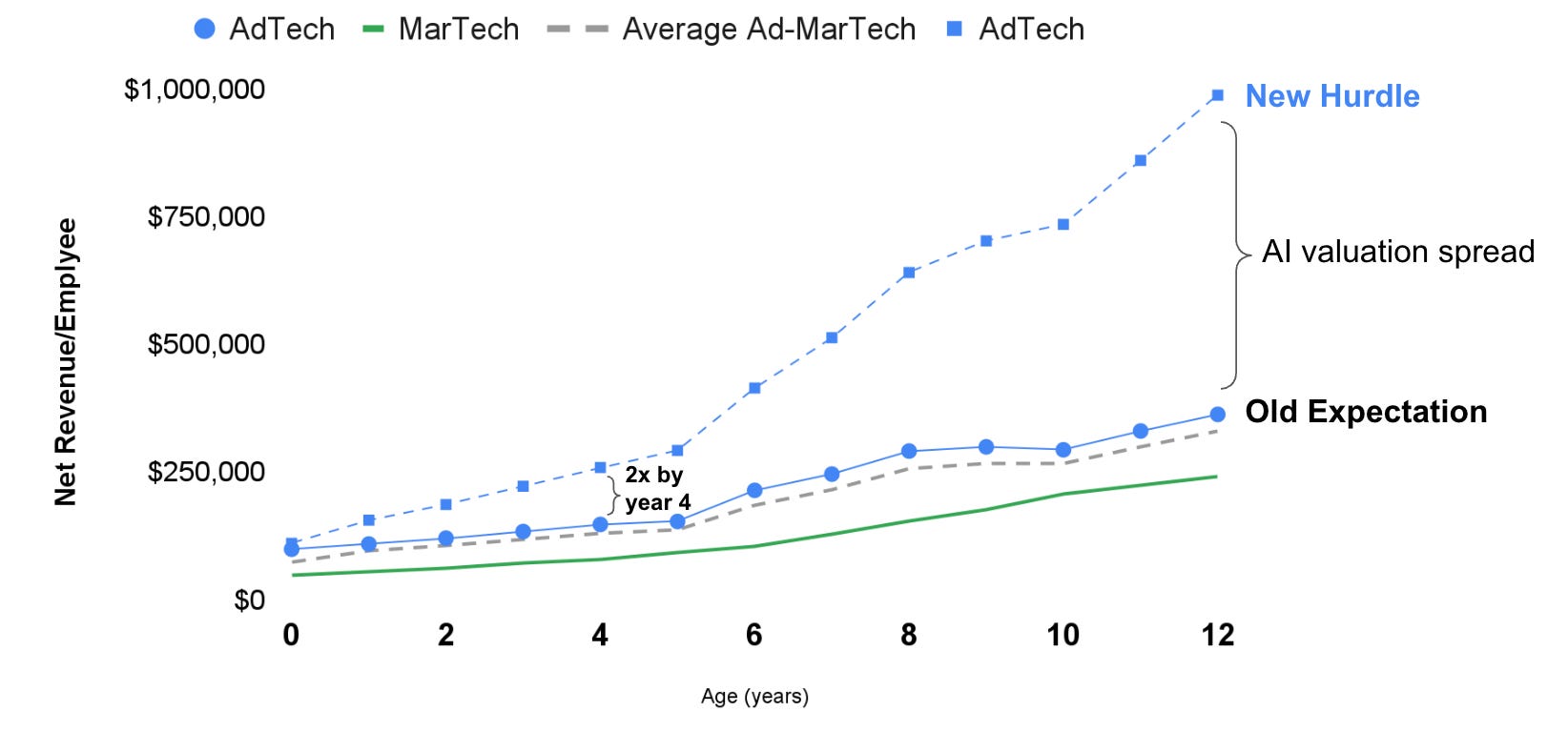
By the 12th year of life, an average pre-AI adtech company should be $363K/employee. MarTech is a bit lower at $241K. In the future (e.g., now), investors expect a meaningful AI-based expansion in revenue productivity, a much higher hurdle rate on revenue productivity, and much better financial performance relative to other investment alternatives.
How Investors Think About AdTech
Although investors might not verbalize it, this is how they think about the intersection of adtech and investing criteria.
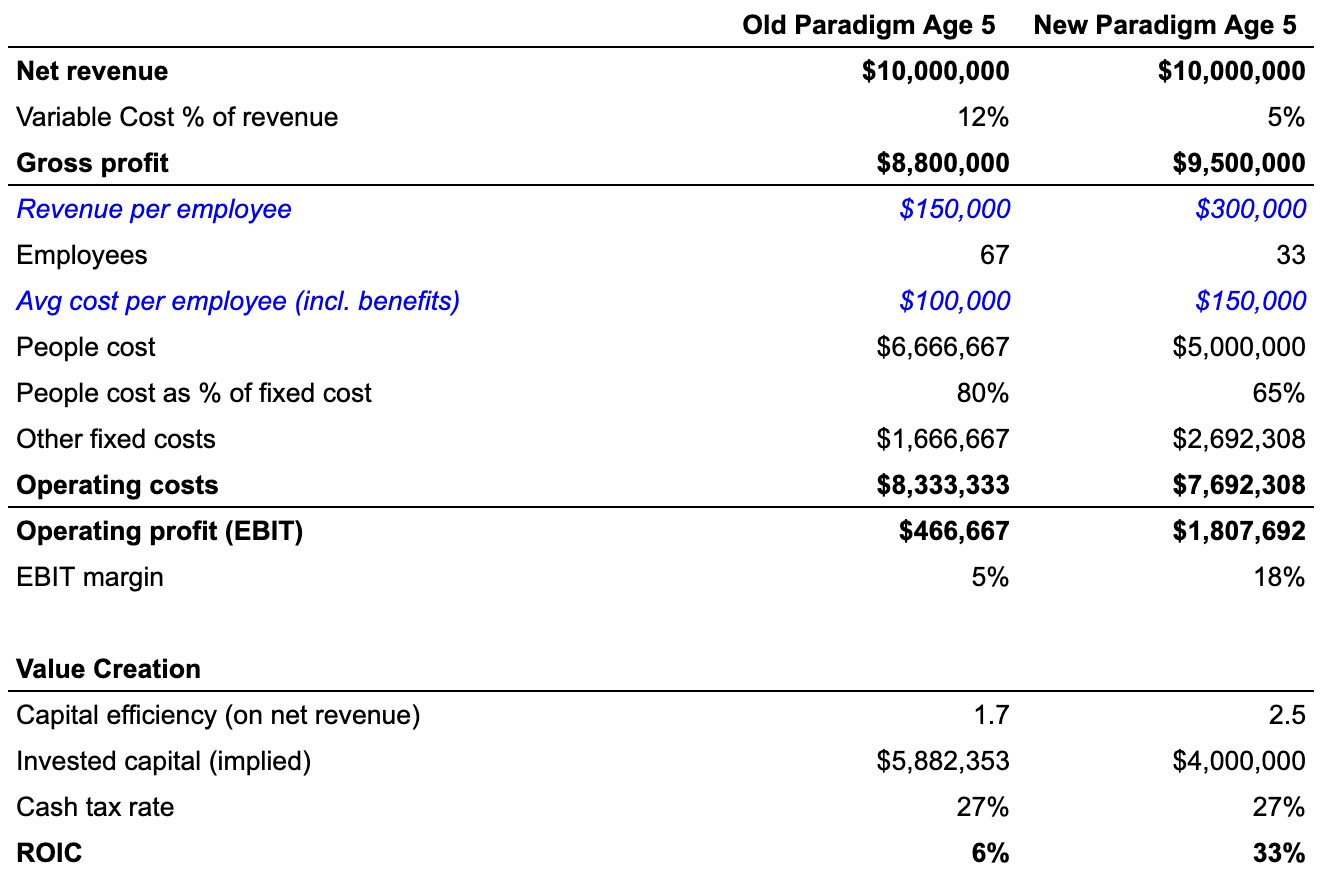
Consider a 5-year old adtech company that processes gross ad spend, collects a take rate, and earns $10 million in net revenue.
In the old paradigm, the cost of revenue expectation would be around 12%. In the new AI paradigm, let’s say it’s 5% because AI computes more efficiently than before.
Let’s also say investor expectations on revenue per employee have doubled from $150K to $300K, cutting required headcount in half.
Let’s increase all-in salary/benefits by 50%. The humans working in the new paradigm are top-notch, creme de la creme talent. On average, they earn more than before.
In the old adtech financial structure, 80% of fixed costs are people costs. In the new AI workplace, it drops to 65%. On a nominal basis, non-people fixed increases because the cost of AI is not, and will not be, free. But the benefits far outweigh the costs.
The difference in expected operating profit (EBIT) is material, increasing from 6% (C-) to 18% to (A-).
In addition, investor expectations on capital efficiency (net revenue ÷ invested capital) will likely increase with AI in play everywhere. That means new adtech companies will generate more net revenue for the same $1.00 in invested capital. Put another way, the new paradigm adtech company needs less invested capital to generate more revenue and faster.
Bottom Line: Whether investors verbalize it or not, or perhaps prefer to simplify the world by talking about EBITDA or adjusted EBITDA, what always matters most is return on invested capital. The grand majority of older adtech companies have had difficulty breaking above 10% ROIC. Notably, the average cost of capital in adtech land is greater than 11%, which is value-destructive if ROIC is less than that hurdle rate.
For new AI adtech companies (or re-invented companies from the last adtech vintage), investor expectations on ROIC are more in line with what they get from Google, Meta, Applovin, etc. If you can’t deliver it, then why should they invest in you instead of them?
Disclaimer: This post, and any other post from Quo Vadis, should not be considered investment advice. This content is for informational purposes only. You should not construe this information, or any other material from Quo Vadis, as investment, financial, or any other form of advice.


